broadband · mobile · insurance · bills
How to haggle your bills: what to say on the call
A word-for-word script for cutting your broadband, mobile or insurance bill, plus the four numbers to have in front of you before you dial.
· 9 min read
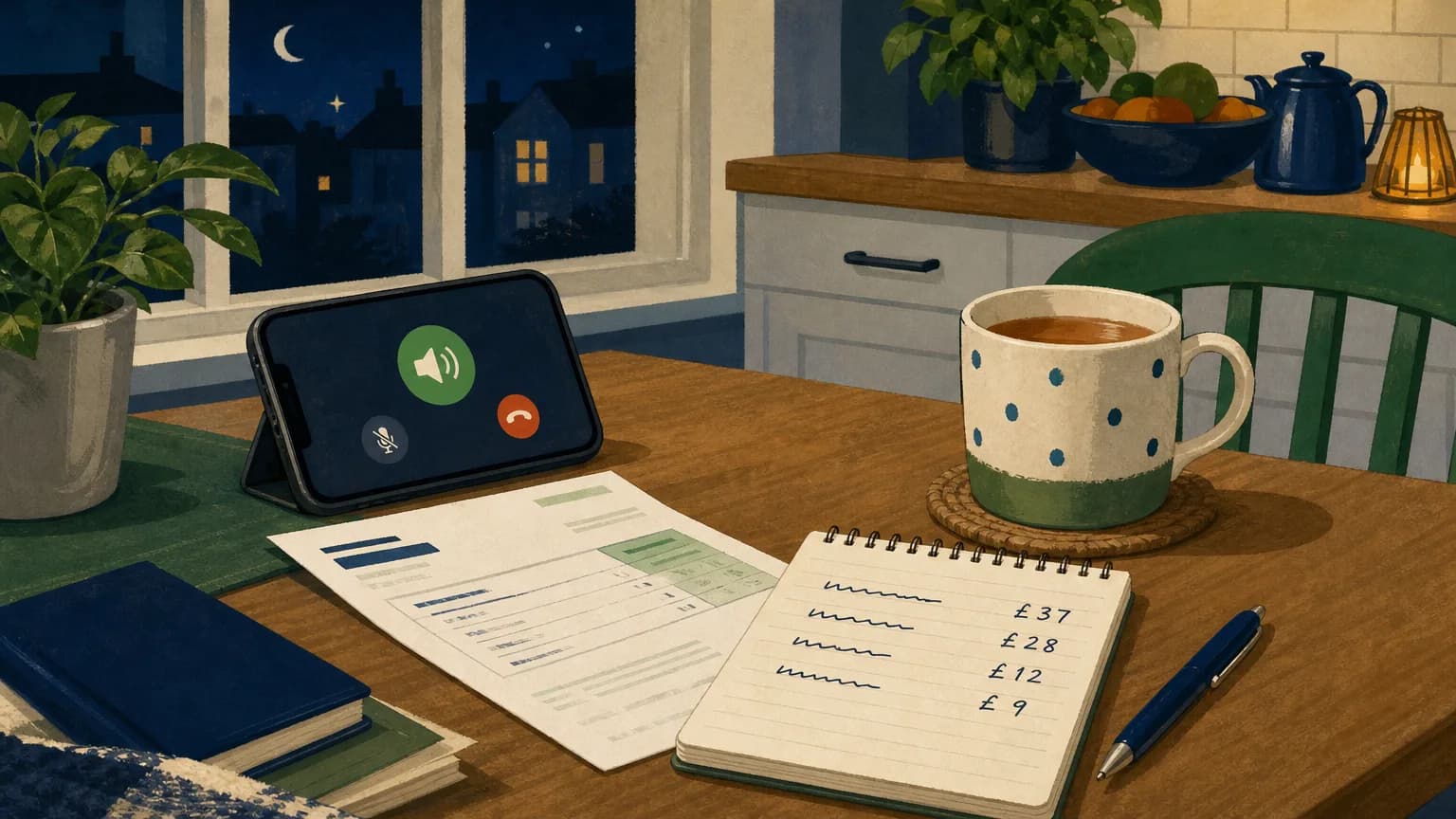
The short answer on how to haggle your bills: write down four numbers, ring your provider, and say "my contract is ending, I've found a cheaper deal, please put me through to the team that handles cancellations." Then read the numbers out, stay polite, and stop talking until they make you an offer.
Autumn is renewal season for broadband, mobile and insurance, so this is the quarter-hour with the best return in the house. You are not being cheeky. For phone, broadband and pay-TV, Ofcom rules mean your provider has already written to you with its own best prices — you are simply asking for what it offered.
Before you ring: the four numbers to write down
Do not dial until these are in front of you, on paper or on screen. The whole call turns on them.
- What you pay now, per month, to the penny. Take it off the latest bill, not memory.
- Your contract end date. If you are past it, write "out of contract" — that is a strong position, not a weak one.
- The best price your own provider has quoted you. Ofcom requires phone, broadband and pay-TV providers to send an end-of-contract notification 10 to 40 days before your minimum term ends, by text, email or letter, including their best available tariffs. If you are already out of contract, they must send you an annual best tariff notification — a yearly reminder of their cheapest deals. Search your email and texts for it.
- The cheapest comparable deal you could actually move to. Same speed, same data, same postcode. Write the provider and the monthly price.
Five minutes of writing turns a vague grumble into evidence. Ofcom's own review of these alerts found some customers saved an average of more than £110 a year by taking a new contract in response to one — that is Ofcom's figure and it is a few years old, so treat it as an illustration rather than a promise.
The one sentence that gets you to the team who can change the price
The first person who answers usually cannot move your price much. The retentions team — sometimes called customer loyalty, sometimes disconnections — can.
Say this, calmly:
"Hello. My contract has ended and I'm looking at cheaper options elsewhere, so I'd like to speak to the team that handles cancellations, please."
That is the whole trick to a retentions team script. You have not been rude, you have not lied, and you have told them why you are worth passing on. If you are wondering what to say to cancel broadband, it is the same sentence — you decide at the end of the call whether you meant it.
A word-for-word script you can read off the screen
Read it out. Nobody can tell.
- Open: "I've been with you [X] years and I'd rather stay, but I'm paying £[current] a month and [rival] has quoted me £[rival price] for the same thing."
- Use their own number: "Your own end-of-contract letter says your best price is £[their best]. Can you put me on that, or better?"
- Ask once, clearly: "What's the best you can do today?"
- Then say nothing. Let the silence sit. Most people fill it by talking themselves out of a discount.
- When an offer comes: "Is that the total, including line rental and any set-up fee? And what happens to the price at the end of the term?"
- Close: "That works. Please email me confirmation of the price, the contract length and the end date before we finish."
Same approach if you want to negotiate a mobile contract. One extra question there: if your handset is paid off, ask for a SIM-only price, because you may still be paying for a phone you own.
What to say when they say no
A first "no" is normal. Try these, in order.
- "I understand you can't. Who can? I'm happy to hold."
- "Then please book the cancellation for the end of my notice period and email me the date."
- "Before I go — is there a cheaper package if I drop [the TV add-on / the landline / the top speed]?"
Booking the cancellation is the moment offers tend to improve, because for broadband and landline the provider no longer controls the exit. Since 12 September 2024, One Touch Switch means you only contact the new provider and it arranges the cancellation, and you do not pay notice-period charges beyond the switch date. So threatening to leave to get a better price is less of a threat than a statement of fact: leaving is now easy.
Your out-of-contract price is your best piece of evidence precisely because it is theirs. They wrote it down and sent it to you.
Ofcom's price rise rules, and how they help you
From 17 January 2025, Ofcom banned inflation-linked and percentage-based price rise terms in new phone, broadband and pay-TV contracts. Any rise built into a contract taken out from that date must be set out in pounds and pence, clearly, before you sign — so "what will this cost in month 19?" is now a question they must be able to answer.
Contracts signed before that date can still carry inflation-linked rises, so check yours. Ofcom's research found only 16% of broadband customers and 12% of mobile customers on inflation-linked deals both knew a rise was coming and could identify how it was calculated.
So add one line to the script: "Is this price fixed for the full term, and if not, exactly how much will it go up by?"

The deal is not done until it is in your inbox.
Get it in writing, then check the first bill
An offer agreed on the phone is not a deal until it is in your inbox. Ask for the confirmation email while you are still on the call, and read it before you file it.
Under the Consumer Contracts Regulations you generally have 14 days to cancel a contract agreed over the phone or online, so if the email does not match what was said, you have room to move. Then diarise one job: check the first bill after the change lands, and the one after that. Introductory discounts have a habit of not applying.
If a bill is wrong and the provider will not fix it, telecoms and energy complaints can be escalated to an independent ombudsman scheme after eight weeks, or sooner if you get a deadlock letter.
When haggling is the wrong move
Sometimes the phone call is not the answer.
- If you claim Universal Credit, Pension Credit or certain other benefits, ask your provider about a broadband social tariff instead. Ofcom has reported these at roughly £10 to £20 a month, they do not show on comparison sites, and take-up remains low. Ask by name.
- For energy, you cannot really haggle. Ofgem's price cap limits the unit rate and daily standing charge on default tariffs and is reviewed every three months, so the useful question is "what fixed deals do you have, and how do they compare to the cap?" The cap covers England, Scotland and Wales; Northern Ireland is regulated separately by the Utility Regulator.
- For car and home insurance, Financial Conduct Authority rules in force since 1 January 2022 mean your renewal price must be no higher than the equivalent new-business price for the same cover. Haggling still helps, but the bigger win is checking the cover level rather than chasing pennies.
- If you are already behind on payments, do not open with a discount request. Ring and ask for an affordable payment arrangement, and get free help from Citizens Advice, StepChange or National Debtline. LiveCheaper is not a financial adviser.
Keep a note so next year takes 10 minutes
One line in your phone's notes app after every call: date, who you spoke to, the agreed price, the contract end date, and the rival quote you used. Set a reminder for 40 days before the end date.
Next autumn you will not be starting from scratch. You will be reading last year's note down the phone.
Questions people ask
Does threatening to leave actually work?
Saying you are ready to leave works better than saying you are unhappy, because it moves you to a team with authority to change prices. Be willing to follow through, because since One Touch Switch started in September 2024 broadband switching is handled by the new provider anyway.
What if I'm still mid-contract?
You have less leverage, but it is still worth asking whether a cheaper package exists for your usage. If your provider raises the price beyond what your contract set out, check your terms and Ofcom's guidance, as there may be a right to exit.
Do I need to be rude to get a discount?
No, and it usually backfires. Polite, specific and slightly boring beats angry every time: a real number, a real rival quote, and a clear question.
Can I do this by web chat instead?
Yes, and it has one advantage — you get a written transcript. Save or screenshot it, because that is your evidence if the first bill is wrong.
What to do next
Start with the numbers. Photograph your latest bill on /scan to see what you are actually paying, then set a reminder for your renewal dates on /bills so no contract quietly rolls over.
If energy is the bill that hurts, check yours against the cap on /energy-check. If you are behind on anything, go to /help-with-debt first — free advice before negotiation. More plain-English guides are on /helpful-tips.
Where this comes from
- Ofcom — End-of-contract notifications driving better deals for customers
- Ofcom — Ofcom bans mid-contract price rises linked to inflation
- Ofcom — Helping consumers get better deals (statement)
- Ofcom — Simpler and quicker broadband switching is here (One Touch Switch)
- Ofcom — Half of low-income households in the dark over broadband social tariffs
- Ofgem — Changes to the energy price cap
- Financial Conduct Authority — General insurance pricing practices
- Citizens Advice — Cancelling a service you bought over the phone or online
Would this answer somebody else’s question too?