fuel · driving · household bills
Cheapest petrol near me: tips that actually work
Pump prices can differ by pence a litre on the same road. Here's how to find the cheap forecourt, and when a detour costs more than it saves.
· 8 min read
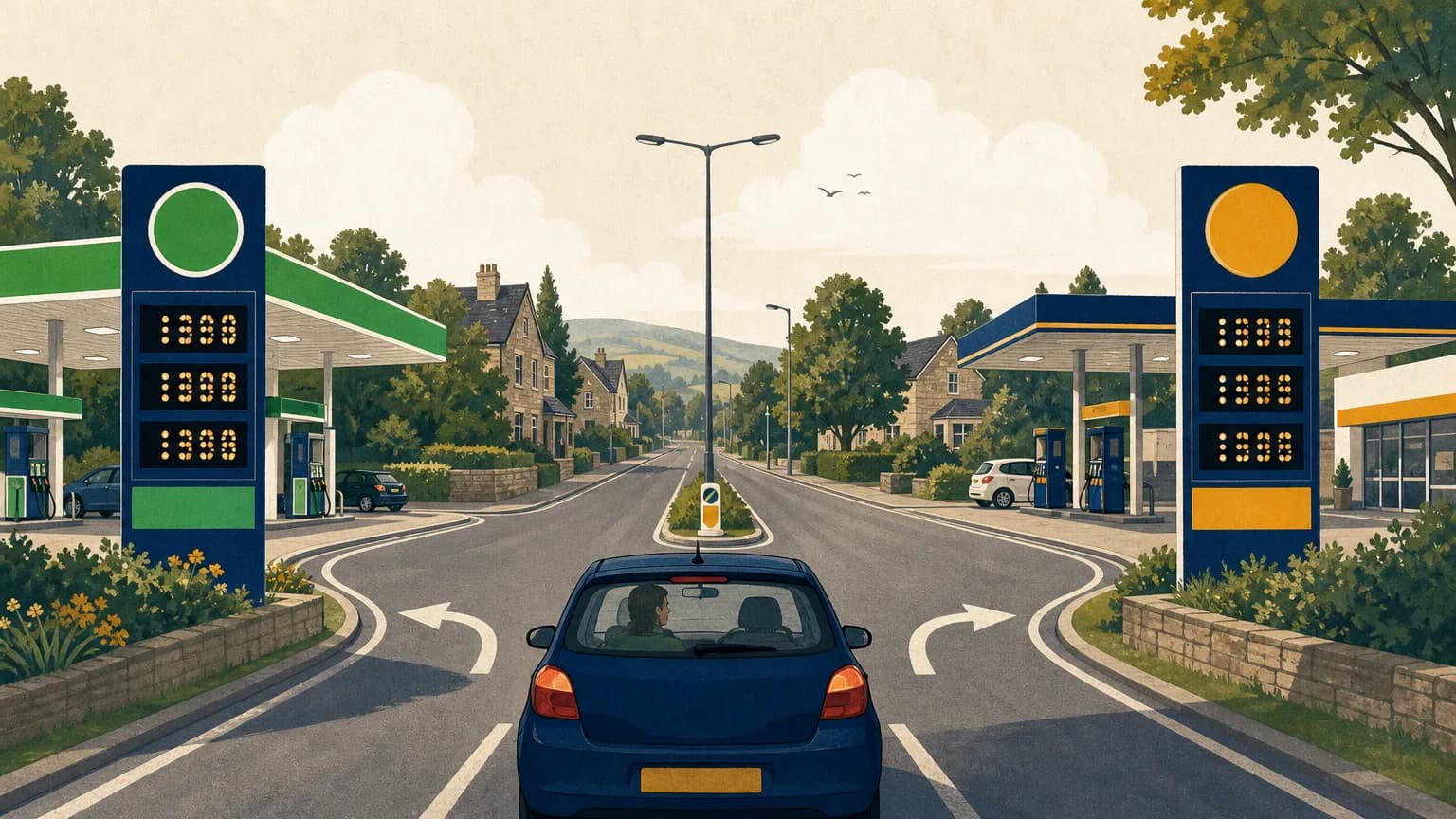
The quickest way to pay less at the pump is to compare prices before you set off, then only drive to the cheaper forecourt if the saving beats the fuel and time the detour costs. Everything else — smoother driving, correct tyre pressures, taking the roof box off — trims the amount you burn between fills.
Most "cheapest petrol near me" tips are worth about 2p a litre each. Stacked together, on a 50-litre fill, they add up to a few pounds every visit, which is real money over a year.
Why two forecourts a mile apart can differ by pence a litre
Duty and VAT are set nationally, so they are the same at every pump in the United Kingdom. What varies is what the retailer adds on top.
The Competition and Markets Authority calls that gap the retail spread — the difference between what a retailer pays for fuel and what it charges you. In its annual road fuel monitoring report published on 22 December 2025, the regulator found the spread finished October 2025 at 12.6p a litre, and averaged more than double the 2015 to 2019 average of 6.5p a litre across the year.
That gap is decided site by site. A forecourt with no rival within three miles has less reason to sharpen its pencil than one facing a supermarket across the roundabout.
One assumption worth dropping: supermarket fuel prices are not automatically the cheapest any more. The same report found supermarket margins per litre eased only slightly, from a 2022 peak of 10.9p to 9.6p over January to September 2025. Check, don't assume.
How the fuel price transparency scheme helps you compare
Since February 2026 every petrol station in the UK — roughly 8,279 sites — has had to publish its pump prices as open data and report any change within 30 minutes, under the Motor Fuel Price (Open Data) Regulations 2025. The scheme is known as Fuel Finder, and it replaced the voluntary arrangement the Competition and Markets Authority set up after its 2023 road fuel market study found competition between retailers had weakened.
Sites also have to report facilities such as an air pump, water, a car wash, AdBlue, 24-hour fuel and customer toilets.
There is no single official government app. The data is published openly so that map services, sat-navs, in-car systems and independent tools can use it — LiveCheaper's fuel page is one of them.
One caveat: the Competition and Markets Authority said its focus in the early months was on helping retailers register and report accurately rather than punishing them, so you may still meet the odd stale price. If the board disagrees with your screen, the board is what you pay.
Check prices on your phone before you leave the house, not once you are already on the forecourt with the nozzle in your hand.
Working out what a detour really costs before you drive it
Do this on the back of an envelope once and you will never argue with yourself about it again.
- Work out the saving: litres you will buy × pence saved per litre ÷ 100. A 50-litre fill at 4p a litre cheaper saves £2.00.
- Work out the fuel the detour burns: extra miles ÷ miles per gallon × 4.546 = litres. A six-mile round trip at 40 miles per gallon burns about 0.68 litres.
- Multiply those litres by the price per litre. At around £1.35 — close to the average petrol price the Competition and Markets Authority recorded for the year to October 2025 — that detour costs about 92p.
- Subtract. You are £1.08 up, before you count fifteen minutes of your evening.
The honest conclusion is that a special trip is rarely worth it. Small savings are worth chasing when the cheaper station is already on a route you drive anyway — the school run, the commute, the road to your parents.
The half-tank rule
Don't run the tank to fumes hoping for a cheap fill. Once you are down to the warning light you lose the choice, and you will pay whatever the nearest forecourt asks. Start looking around a quarter to a third of a tank.
Driving habits that cut what you burn
Nobody can promise you a percentage, because it depends on your car, your load and your roads. But the physics is not in doubt.
- Speed. Air resistance rises steeply with speed, so a motorway run at 70 miles per hour uses noticeably more per mile than the same run at 60.
- Tyres. Under-inflated tyres drag. Check pressures monthly against the figure in your handbook or the door sill, and use the higher "laden" figure when the car is full.
- Roof bars and boxes. They wreck the aerodynamics. Take them off when you are not using them.
- Dead weight. Empty the boot of the things that have lived there since March.
- Smoothness. Reading the road ahead so you brake less and accelerate gently is the single biggest habit change most drivers can make.
- Short cold trips. An engine is at its thirstiest in the first couple of miles from cold. Combining errands into one trip beats three separate ones.

Two minutes at the table beats guessing at the pump.
Loyalty schemes and price promises: read the small print
Fuel loyalty offers are usually genuine but narrower than the poster suggests. Before you rely on one, check four things:
- Is there a minimum spend, or a cap on the number of litres the discount applies to?
- Does it work at every site, or only at company-owned ones and not franchises?
- Do points or vouchers expire, and does the discount come off now or on a later shop?
- If it is a price match, which rivals is it matched against, and how far away are they?
If a fuel price claim turns out to be misleading, the Competition and Markets Authority can now enforce consumer protection law directly, and you can report it to Citizens Advice, which passes reports to Trading Standards.
Premium grades, diesel and E10: when the extra is wasted
Standard unleaded in the UK is E10, containing up to 10% bioethanol. GOV.UK has a free E10 vehicle checker for older cars and motorbikes; if yours is not compatible, E5 super unleaded is the fallback, which is why some drivers pay more without choosing to.
Otherwise, the test is simple: open the handbook. If your car's manufacturer specifies ordinary 95 octane unleaded or standard diesel, the premium grade at 10p or more a litre extra is money you did not need to spend. If it specifies a higher octane, use it — engines designed for it can lose efficiency on the cheap stuff.
Diesel price comparison is worth doing separately from petrol, by the way. The gap between the two fuels moves independently, and a forecourt that is keen on unleaded is not always keen on diesel.
Set up a weekly price check
Make it a two-minute habit rather than a research project.
- Pick one day a week — payday or the day before your big shop.
- Check the three or four forecourts on routes you already drive.
- Note the cheapest and fill up on your next planned trip past it.
- Once a month, do the tyre pressures at the same time.
In Northern Ireland it is also worth watching the exchange rate if you cross the border, as fuel in the Republic of Ireland is priced in euro and the comparison shifts with the rate.
Questions people ask
Is there an official government fuel price app?
No. Under the Fuel Finder scheme the price data is published openly for third parties, sat-navs and map services to use, so you choose the tool you prefer.
How often do stations have to update their prices?
Within 30 minutes of changing them, under the Motor Fuel Price (Open Data) Regulations 2025. That is why the data is usually close to the board, though errors still happen while retailers bed in.
How much of a litre is tax?
A large chunk. Fuel duty has included a temporary 5p cut since 2022, and the November 2025 Budget set out a staged reversal — check the current rate on the GOV.UK fuel duty rates page, as the timetable has moved more than once.
Does filling up in the morning get you more fuel?
No, this one is a myth. Underground tanks barely change temperature over a day, and the pump measures volume you are charged for regardless.
Are supermarket fuel prices always cheapest?
Not any more. Competition and Markets Authority monitoring shows supermarket margins per litre well above pre-2020 levels, so compare the actual prices rather than trusting the brand.
What to do next
Start with a live comparison of the forecourts near you on the LiveCheaper fuel page, then set a weekly reminder so it becomes a habit rather than a chore.
If fuel is one of several costs squeezing you, the MOT, tax and insurance reminders page helps you avoid the fines that cost far more than a tank, and Helpful Tips covers the rest of the household budget. If you are borrowing to fill up, speak to Citizens Advice, StepChange or National Debtline — all free, all independent — and see debt letter help for your rights.
Where this comes from
- Competition and Markets Authority: Road fuel monitoring annual report (December 2025)
- The Motor Fuel Price (Open Data) Regulations 2025 — impact assessment
- Competition and Markets Authority blog: Driving better road fuel prices for consumers
- GOV.UK: Fuel duty rates
- GOV.UK: E10 petrol explained (vehicle compatibility checker)
- Fuels Industry UK: Fuel Finder scheme — essential information
- Office for Budget Responsibility: Fuel duties
Would this answer somebody else’s question too?