benefits · pension credit · council tax · universal credit
What benefits can I claim? A plain-English check
Billions in support goes unclaimed every year. Here is a plain-English check of what benefits you can claim, even if you work, own your home or have savings.
· 8 min read
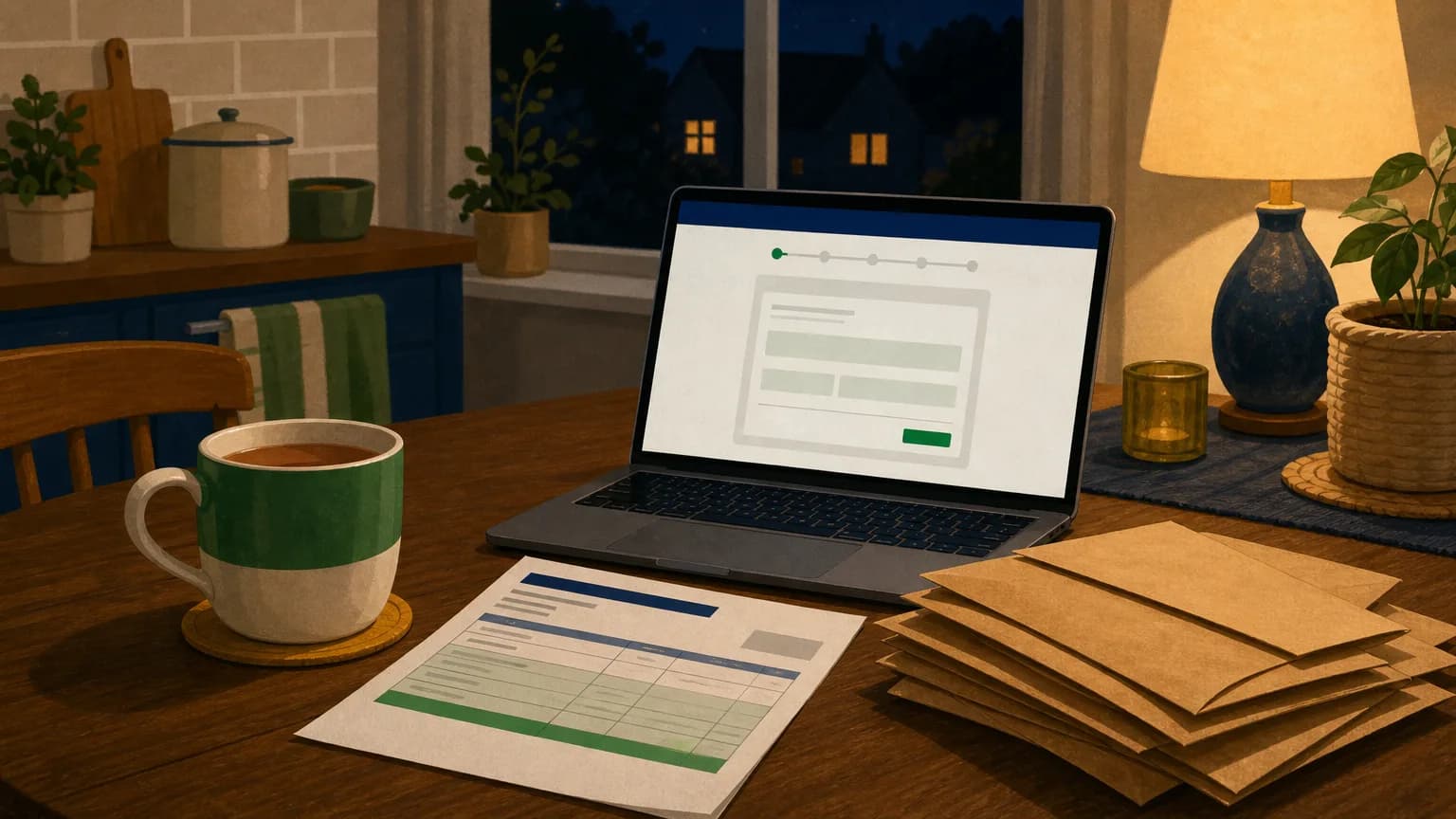
If you are asking what benefits can I claim, the honest answer is that nobody can tell you from the outside — but a free benefits calculator will tell you in about ten minutes. Working, owning your home, having savings or having been turned down before do not automatically rule you out, and every winter households miss money they were entitled to all along.
This is a walk through the main things worth checking, in the order most people find money.
Working, and still eligible: the myth that stops most claims
The single biggest reason people miss out is thinking benefits are only for people out of work. Universal Credit is designed to be paid alongside earnings — as you earn more, the payment reduces gradually rather than stopping dead.
From 6 April 2026 the Universal Credit standard allowance is £424.90 a month for a single person aged 25 or over and £338.58 if you are under 25, according to the House of Commons Library. For couples it is £666.97 a month where one or both of you are 25 or over, and £528.34 if you are both under 25.
On top of the standard allowance you may get amounts for children, for housing costs, for childcare, for a health condition or for caring. That is why two households with the same wage can end up with very different entitlements.
One warning about work and Carer's Allowance. Carers UK points out that the earnings limit is a cliff edge: earn even £1 over it and you lose the whole payment, not part of it. From April 2026 the limit is £204 a week after allowable deductions, and the allowance is £86.45 a week.
The three things to check first
Run a free benefits calculator listed on GOV.UK before you do anything else — it covers most of the list below in one go.
- Universal Credit. For most working-age households on a low income, whether you are employed, self-employed or not working. It has replaced most of the old means-tested benefits.
- Pension Credit. For people over State Pension age on a low income. Guarantee Credit tops your weekly income up to £238.00 if you are single and £363.25 for a couple in 2026/27, and there are extra amounts of £86.05 a week for severe disability and £48.15 a week for carers, according to Age UK's Pension Credit factsheet. Pension Credit eligibility is not ruled out by owning your home or having modest savings, and roughly a third of eligible pensioners have historically not claimed it.
- Council Tax Reduction. Run by your local council, not the Department for Work and Pensions, and you have to apply separately. Working-age schemes vary from council to council in England; Scotland and Wales run their own national schemes; Northern Ireland has domestic rates with rate relief instead of council tax.
Council Tax Reduction is the one people most often forget after a change in income. It is a separate form even if you already claim Universal Credit.
Help linked to a health condition or caring for someone
These are not means-tested, so your income and savings do not matter.
- Attendance Allowance is for people over State Pension age who need help or supervision because of a health condition or disability. From April 2026 it is £76.70 a week at the lower rate and £114.60 a week at the higher rate, per the Department for Work and Pensions rates table. You do not need to have a carer, and you do not need someone to be physically helping you now.
- Personal Independence Payment does the same job for working-age people in England and Wales. Scotland has Adult Disability Payment and Pension Age Disability Payment instead.
- Carer's Allowance is for people caring at least 35 hours a week for someone who gets a qualifying disability benefit. In Scotland this is Carer Support Payment.
These are about the help you need day to day, not your diagnosis. Plenty of people who describe themselves as "managing fine" qualify.
One award can unlock several others
This is where unclaimed benefits get expensive. A small award of one benefit often acts as a key to others.
Pension Credit is the clearest example: even a few pence a week of Guarantee Credit can open the door to help with rent, Council Tax Reduction, NHS costs and a free TV licence for over-75s. An award of Attendance Allowance or Personal Independence Payment can increase Universal Credit or Pension Credit, and can mean the person caring for you qualifies for Carer's Allowance.
So it is worth claiming even when the amount looks trivial. The amount is rarely the point.
Housing and childcare costs you may not be claiming for
If you rent, help with rent usually comes through the housing element of Universal Credit for working-age households, or Housing Benefit if you are over State Pension age or in supported or temporary accommodation.
Savings matter here. Shelter's legal guidance says that for working-age Housing Benefit, capital over £16,000 rules you out unless you get Guarantee Pension Credit, and capital between £10,000 and £16,000 is treated as producing £1 a week of income for every £500 above £10,000.
If you pay for childcare and you are working, Universal Credit can refund a large share of registered childcare costs up to a monthly cap — check the current figures on GOV.UK, as they changed in April 2026. That sits alongside the funded early-years hours in England, and the separate schemes in Scotland, Wales and Northern Ireland.

A small award can be the key that unlocks several other forms of help.
Free calculators and free help with the form
GOV.UK lists independent benefits calculators that are free and anonymous. Have your rent or mortgage figure, recent payslips, savings balances and childcare costs to hand and it takes about ten minutes.
For help actually filling the form in, all of these are free:
- Citizens Advice runs Help to Claim for new Universal Credit claims.
- Age UK helps with Pension Credit and Attendance Allowance forms.
- Advice NI is the equivalent first stop in Northern Ireland.
- Your local council's welfare rights team, if it has one.
If you are behind on bills as well as under-claiming, speak to StepChange, National Debtline or Citizens Advice. They are free, and you should never pay a company for debt advice.
If you are refused: mandatory reconsideration, then appeal
A refusal is common and it is not the end. The Department for Work and Pensions' own Personal Independence Payment statistics show that for the quarter ending January 2026, 35% of new claims that were decided resulted in an award — so most people who apply are turned down first time, and many win later.
The route is:
- Ask for a mandatory reconsideration — a second look at the decision. You normally have one month from the date on the decision letter, and you can ask late if you have a good reason.
- If that fails, appeal to the independent tribunal. In England, Scotland and Wales that is the First-tier Tribunal (Social Security and Child Support); in Northern Ireland it is the Appeals Service.
- Get free help from Citizens Advice or Advice NI before the hearing. Representation makes a real difference and costs you nothing.
Say what daily life is actually like on a bad day, not a good one, and give examples.
Scotland, Wales and Northern Ireland: different names, different systems
Scotland now runs several benefits through Social Security Scotland, including Adult Disability Payment, Child Disability Payment, Pension Age Disability Payment, Carer Support Payment, the Scottish Child Payment and Best Start Grant — check mygov.scot rather than GOV.UK.
Wales runs its own national Council Tax Reduction Scheme and additional schemes such as the Discretionary Assistance Fund. In Northern Ireland, benefits are delivered by the Department for Communities, some rules and dates differ, and rates relief replaces Council Tax Reduction — nidirect.gov.uk is the place to look.
Questions people ask
Will claiming affect my tax credits or my pension?
Tax credits have closed and claimants have been moved to Universal Credit or Pension Credit. Claiming Pension Credit does not reduce your State Pension — it tops up your income.
Do savings stop me claiming?
For Universal Credit and Housing Benefit, savings above £16,000 generally rule you out, with tariff income applied between £6,000 and £16,000 for Universal Credit. Attendance Allowance, Personal Independence Payment and Carer's Allowance ignore savings entirely.
I own my home — is it worth checking?
Yes. The home you live in is not counted as savings, and Attendance Allowance, Personal Independence Payment and Pension Credit are all open to homeowners.
How far back can a claim be paid?
Usually not far — most benefits start from the date you claim, though Attendance Allowance can be paid from the date you first phoned for the form. That is why delaying costs real money.
Is a benefits calculator safe to use?
The calculators listed on GOV.UK are free, independent and do not ask for your name or National Insurance number. Nobody is told that you used one.
What to do next
Start with the LiveCheaper benefits finder to see what is worth checking in your situation, then run a free calculator listed on GOV.UK and put the claim in the same day.
While you are at it, check your council tax band — a wrong band and a missed Council Tax Reduction often sit in the same household. If bills are the pressure point this winter, the energy bill check and the warm home check are the next two to run. If you are dealing with debt letters, our debt help page points you to the free charities.
Where this comes from
- Benefits Uprating 2026/27 — House of Commons Library
- Proposed benefit and pension rates 2026 to 2027 — GOV.UK
- Statutory Review of State Pension and Benefit Rates 2026/27 — Written Ministerial Statement
- Personal Independence Payment: Official Statistics to January 2026 — GOV.UK
- Check how Universal Credit has changed in 2026 — Citizens Advice
- Pension Credit factsheet 48 — Age UK
- Carer's Allowance: help and advice — Carers UK
- Housing Benefit calculation rates 2026 to 2027 — Shelter Legal England
Would this answer somebody else’s question too?