energy · heating · insulation · grants
Warm home check: the cheap fixes that save the most
A half-hour check in September costs nothing and beats a December call-out. Here is how to keep your house warm cheaply, plus the grants worth chasing now.
· 9 min read
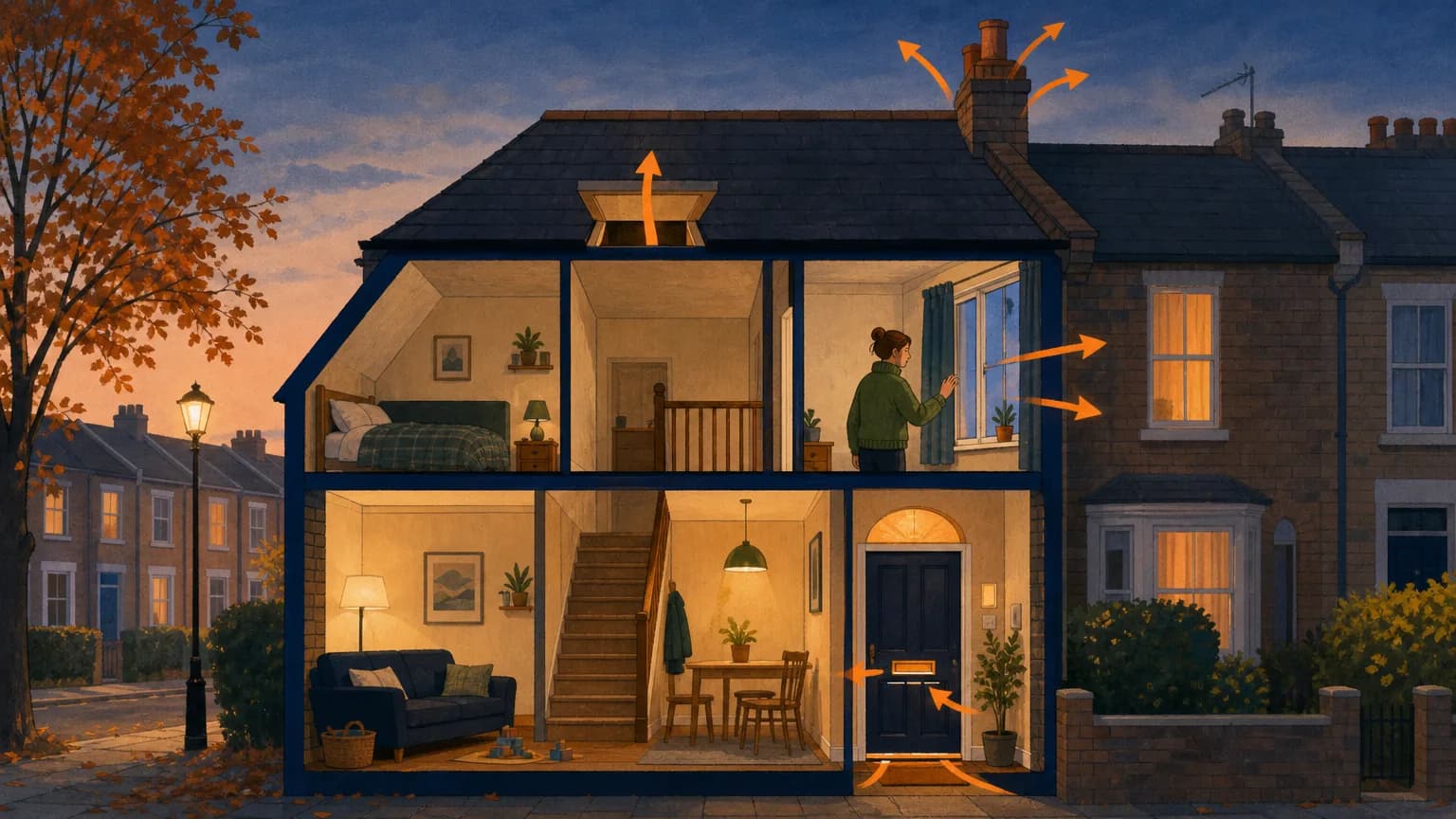
The cheapest way to keep your house warm is to stop the heat you have already paid for from leaking out, and to make sure the boiler and radiators work properly before the cold arrives. Doing that costs a roll of draught excluder, a radiator key and half an hour of your evening — far less than an emergency call-out in December.
This guide is about how to keep your house warm cheaply: what to check tonight, what actually moves your bill, and which grants you may qualify for before they close.
The half-hour check: draughts, radiators and your thermostat
Do these in one go, with the heating on, so you can feel what is wrong.
- Walk every room with the back of your hand at knee height. Letterbox, keyhole, loft hatch, under skirting, floorboards, cat flap, unused chimney, the gap where pipes come through a wall. Cold on your skin means money going out.
- Feel each radiator top and bottom. Cold at the top and warm at the bottom usually means trapped air, and it needs bleeding.
- Check nothing is parked in front of a radiator — a sofa, a drying rack, thick curtains hanging over it.
- Find your room thermostat and read what it actually says, not what you think you set it to.
- Look at the timer. Most people are heating an empty house at some point in the day.
Bleeding a radiator, safely
Turn the heating off and let the radiators cool. Put a cloth and a bowl under the valve at the top corner, turn the radiator key a quarter turn until you hear hissing, and close it the moment water appears. Then check the boiler pressure gauge afterwards — bleeding several radiators can drop it, and your boiler manual will say what pressure it should sit at.
Which fixes actually cut your bill, and roughly by how much
Be wary of anyone quoting exact savings. Most figures floating around online were priced at old energy costs, and the Energy Saving Trust publishes different numbers for Great Britain and for Northern Ireland because unit prices differ.
What we can say is what an hour of warmth costs. Under Ofgem's price cap for 1 October to 31 December 2026, a typical dual-fuel household paying by direct debit is capped at £1,723 a year, a 4% rise on the previous period, with electricity at an average 26.32p per unit and a 54.83p daily standing charge across England, Scotland and Wales. One caution from Ofgem: there is no VAT on electricity from 1 October 2026 to 31 March 2027, so any headline comparing this winter's bills with last winter's is not comparing like with like. The cap only applies to standard variable tariffs, not to fixed deals.
In rough order of money saved for money spent:
- Draught proofing doors, windows, letterboxes and the loft hatch. Cheap, and you feel it the same evening.
- Loft insulation topped up to full depth, if yours is thin or squashed flat.
- Using your controls properly — timer, room thermostat, radiator valves. Free.
- Reflective panels behind radiators on outside walls.
- Heavy or lined curtains closed at dusk, opened when the sun is on that side.
One warning from the Energy Saving Trust: if your home is already well sealed, adding more draught proofing can make air quality worse. Never block an air brick, a trickle vent, or any vent serving a gas appliance or open fire.
If you do pay for work, the Energy Saving Trust advice is to get three quotes from reputable installers and to use TrustMark, the government-endorsed quality assurance scheme, to find certified ones.
Boiler and heating service: book it now, not in November
September and early October are the quiet weeks. By the first hard frost, engineers are booked solid and you pay emergency rates.
- Use the Gas Safe Register to check the engineer is legally registered for gas work, and ask to see their card on the doorstep.
- If you rent, your landlord must arrange an annual gas safety check by a registered engineer and give you a copy of the certificate. Chase it in writing if you have not seen one this year.
- Many boilers are under warranty only if serviced annually — dig out the paperwork before you decide to skip it.
- Test the carbon monoxide alarm while you are at it, and replace it if it is past its expiry date.
Heating controls most people never touch
The room thermostat sets how warm the house gets. NHS winter advice is to heat the rooms you use to at least 18°C, and to be more careful than that if someone in the house is elderly, very young, or unwell. Warmth is a health matter, not just a bill.
Thermostatic radiator valves let you turn rooms you barely use down a notch, rather than heating the whole house to bedroom-guest standard.
If you have a condensing combi boiler, there is a second dial most people never touch: the flow temperature, which controls how hot the water is that goes round your radiators. The Energy Saving Trust's guidance is that turning this down can help a condensing boiler run more efficiently, without changing how warm you keep the house.
One thing not to fiddle with: if you have a hot water cylinder, do not turn its thermostat below 60°C. Lower than that risks legionella bacteria in the stored water. Ask a registered engineer if you are unsure.

A radiator key and a roll of draught strip cost less than one emergency call-out.
Free or grant-funded insulation: who qualifies, and the deadline
Two schemes matter, and both are run through energy suppliers rather than as a form you fill in.
The Energy Company Obligation (ECO4) closes to installations on 31 December 2026, according to Ofgem. If you might qualify, start the conversation now. It covers Great Britain only, not Northern Ireland. You must own your home or have your landlord's written permission, and a retrofit assessment decides what measures your home needs. Ofgem is blunt that ECO is not a grant you apply for and receive — suppliers choose which projects to fund. There is also an ECO4 Flex route for households in persistent fuel debt, or on prepayment meters who keep being cut off because they cannot afford to top up.
The Great British Insulation Scheme has a Flex route for households with a combined gross income under £31,000 a year, or where someone has a severe or long-term health condition. Ofgem notes your council can refer you to suppliers too, so try both — but eligibility does not guarantee anyone will install anything.
In Scotland, Home Energy Scotland is the free advice line; in Wales, ask about the Nest scheme; in Northern Ireland, contact your local council and the Housing Executive, as ECO does not apply there.
Damp and condensation: cheap habits, and when it is not your fault
Condensation is warm damp air meeting cold surfaces. The cheap habits: lids on pans, extractor fan on and window ajar for a few minutes after showering, bathroom and kitchen doors shut while steam is being made, and wardrobes pulled a few inches off outside walls.
Drying washing indoors on radiators puts litres of water into the air. If you must, do it in one room with the door shut and a window cracked.
But black mould spreading up a wall from the skirting is often disrepair, not housekeeping. Report it to your landlord in writing and keep photographs. For social housing tenants in England, Awaab's Law sets legal deadlines for landlords to investigate and fix damp and mould. Private renters anywhere in the UK should speak to Citizens Advice or their council's environmental health team.
If your heating fails and you have no money to fix it
- Join your supplier's Priority Services Register today — it is free, it takes minutes, and Ofgem widened the rules so temporary situations count, not just permanent conditions. Registered customers get extra help from suppliers and network operators.
- The Warm Home Discount is a £150 credit applied by participating suppliers in England, Scotland and Wales. Eligibility depends on getting certain benefits on a single qualifying date each year, and Scotland's qualifying benefits are set separately by Scottish Ministers. Very small suppliers may not take part.
- For winter 2026/27, the Winter Fuel Payment qualifying week is 21 to 27 September 2026. You need to have reached State Pension age by the end of that week and have income of £35,000 a year or below. Most people are paid automatically; check the GOV.UK Winter Fuel Payment page if you have never had it.
- Ask your council about local hardship or crisis help. It varies enormously by area and is rarely advertised.
- If energy debt is the real problem, ring a free charity before you ring anyone else: StepChange on 0800 138 1111, National Debtline on 0808 808 4000, or Citizens Advice. Never pay a company for debt advice.
Questions people ask
What thermostat setting saves money without freezing?
Heat the rooms you use to at least 18°C, in line with NHS winter advice, and turn down radiators in rooms nobody sits in. Setting the thermostat higher does not heat the house faster — it just runs the boiler longer.
Is it cheaper to leave the heating on low all day?
For most homes, heating only when you need it costs less, because you are not replacing heat that escapes while the house is empty. The exception is a very well insulated home with a heat pump, which is designed to run gently for longer.
Do I need a boiler service every year?
Many boiler warranties require an annual service, so check yours before skipping it. If you rent, your landlord must arrange an annual gas safety check by a Gas Safe registered engineer and give you the certificate.
Can I get free insulation if I rent?
Possibly. Ofgem's rules for ECO and the Great British Insulation Scheme allow tenants to benefit, but you need your landlord's permission, including in social housing.
Why is my bill higher than last winter even though I used less?
Ofgem's price cap rose 13% in July 2026 and a further 4% from 1 October 2026, so the same energy costs more. Comparisons are also muddied by there being no VAT on electricity from 1 October 2026 to 31 March 2027.
What to do next
Start with the free half-hour check tonight, then see which grants you might qualify for on our warm home check page. Compare what you are actually paying against Ofgem's cap with the energy bill check, and see whether you are missing anything on the benefits finder — Warm Home Discount eligibility usually hangs off a benefit you may not have claimed.
Where this comes from
- Energy price cap: unit rates and standing charges — Ofgem
- Changes to energy price cap between 1 October and 31 December 2026 — Ofgem
- Energy Company Obligation (ECO) — Ofgem
- Energy Company Obligation: homeowners and tenants — Ofgem
- Great British Insulation Scheme: homeowners and tenants — Ofgem
- Warm Home Discount: eligibility — Ofgem
- Getting extra help: the Priority Services Register — Ofgem
- The Warm Home Discount — House of Commons Library
Would this answer somebody else’s question too?