energy · price cap · meter readings · bills
Meter reading before the price cap change: why it matters
Ofgem's price cap rises 4% on 1 October 2026. A reading taken right before the change stops your supplier estimating cheaper units at the new, dearer rate.
· 8 min read
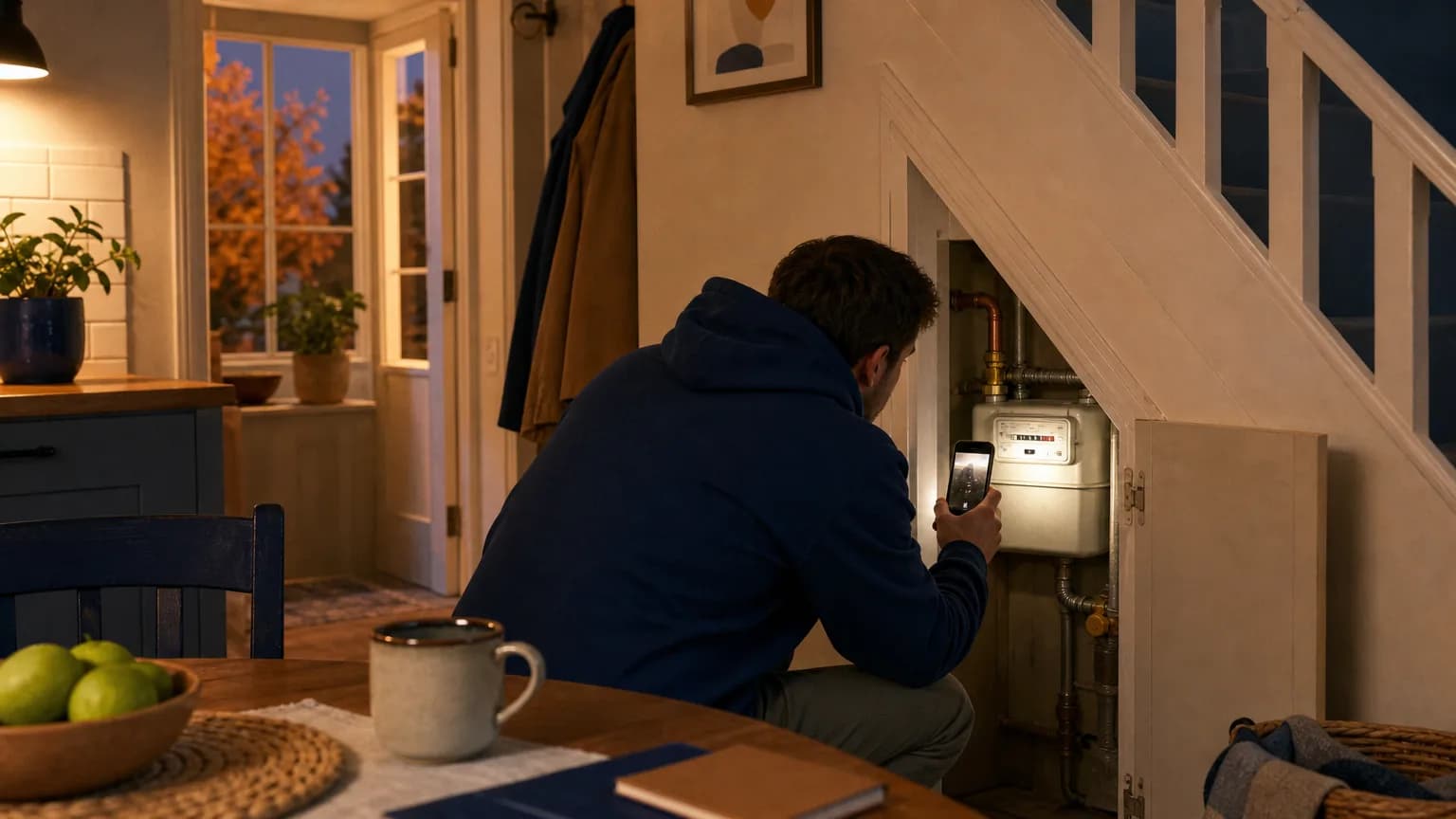
Send a meter reading dated as close to 1 October as you can, because that is the day Ofgem's new energy price cap starts and the day your unit rates change. A meter reading before the price cap change draws a line between energy you used at the old price and energy you use at the new one, so your supplier does not have to guess.
If you have a working smart meter sending automatic readings, or you are on a fixed tariff, you can stop reading here — you do not need to do anything.
What actually changes on 1 October 2026
Ofgem announced on 26 August 2026 that the energy price cap will rise by 4% for the period 1 October to 31 December 2026. For a typical household using gas and electricity and paying by Direct Debit, the cap goes from £1,663 to £1,723 a year — about £5 a month more if that level were sustained for a year.
That headline number is not a cap on your bill. Ofgem's cap limits the maximum unit rates and standing charges a supplier can charge on a default tariff, so if you use more, you pay more.
Under the October to December cap, Ofgem's average Direct Debit rates are 26.32p per kilowatt hour for electricity with a 54.83p daily standing charge, and 7.97p per kilowatt hour for gas. These are averages across England, Scotland and Wales — your actual rates vary by region, payment method and meter type, and Northern Ireland is regulated separately by the Utility Regulator, not Ofgem.
Two things worth knowing. First, most of this rise is gas: Ofgem says gas bills go up around 8%, while households with no gas see an increase of less than 1%. Second, there is no VAT on electricity from 1 October 2026 to 31 March 2027, which is why Ofgem warns these costs cannot be compared directly with earlier periods. Ofgem says that without that VAT change the cap figure would have been roughly £45 higher.
Around 22 million households are protected by the cap. Roughly 35% of households — about 11 million — are on fixed tariffs and are not affected by the October change at all.
Why an estimated reading can quietly cost you
If your supplier has no real reading around 1 October, it estimates where your meter was on that date, usually by spreading your recent usage evenly across the billing period.
That estimate decides how many units get charged at the old, cheaper rate and how many at the new, dearer one. Get the estimate wrong in the supplier's favour and units you actually burned in September end up priced as October.
No regulator or charity publishes an average saving for sending a reading, so be wary of anyone promising you a figure. The point is simpler: an accurate reading means you pay the right price for the energy you actually used, rather than a guess.
This quarter, the reading that matters most is the gas one, because gas is where nearly all of the increase sits.
One thing a reading will not do is dodge standing charges. Under the October to December cap those are roughly 54.8p a day for electricity and 29.7p a day for gas — about 84.5p a day on dual fuel — and the House of Commons Library notes they make up about 18% of a typical dual-fuel bill. You pay them whether you use any energy or not.
When to take your reading, and what to do if you forget
Read your meters on 30 September or 1 October, take a dated photo of each meter face, and submit the numbers the same day.
Some suppliers accept readings for a few days either side of the change. That is supplier policy, not an Ofgem rule, so check the window on your supplier's app or website rather than assuming.
If you miss it entirely:
- Take the reading as soon as you remember and send it anyway. A late real reading is still better than a run of estimates.
- Keep the photo. A timestamped picture of the dials is the evidence that settles arguments.
- Ask your supplier to re-apportion the bill using your reading if you think the split between old and new rates is wrong.
How to read every type of meter
Standard digital meter
Write down the numbers from left to right. Ignore any digits after a decimal point or in a red box.
Dial meter
Read the dials left to right. If a pointer sits between two numbers, take the lower one; if it sits directly on a number, write that number down but check the dial to its right — if that one reads 0 to 1, reduce your number by one.
Economy 7 or two-rate meter
You have two readings, usually marked "low" and "normal", or R1 and R2. Send both. The cheaper night period varies by supplier and region, so do not assume it is the same as a neighbour's.
Prepayment meter
Press the button to cycle through the display until you reach the reading, not the credit balance. Your new rates load onto the meter automatically, but a reading still helps if there is a dispute.
Smart meter
If it is sending readings automatically, you are covered. If it has gone "dumb" after a switch, read it from the in-home display or the meter itself and submit it manually.
If illness, disability or eyesight makes reading your meter difficult, ask your supplier about the Priority Services Register. It is free, and it can include help with meter readings.

On a two-rate meter, send both readings, not just the top one.
Where to send it, and how to check it stuck
Use your supplier's app, online account or automated phone line. Then go back into your account a few days later and check the reading appears as "customer reading", not "estimated".
If your supplier rejects the reading as implausible, that usually means a typo or a missed digit. Re-check the meter face against your photo and resubmit.
What to do if the bill still looks wrong
Compare the unit rates and standing charges on the bill against Ofgem's published cap rates for your region and payment method. Check the reading used on 1 October matches yours.
If you have been undercharged for a long stretch, Ofgem's back-billing rules mean you do not have to pay for energy used more than 12 months ago if you were not correctly billed for it at the time. That protection may not apply if you acted unreasonably — for example, by preventing the supplier from taking accurate readings, or by tampering with the meter.
Complain to your supplier first. If it is not resolved after eight weeks, or you receive a deadlock letter, you can take it to the Energy Ombudsman free of charge.
If you are behind on energy bills, talk to StepChange, National Debtline or Citizens Advice. Their advice is free and independent, and your supplier must work with you on a repayment plan you can afford.
Questions people ask
Do I need to give a meter reading if I have a smart meter?
Not if it is sending readings automatically — the smart meter reading and the price cap change are handled for you. Check your account shows recent automatic readings; if it does not, send one manually.
Does a meter reading save me money?
It does not cut the price you pay per unit. It makes sure the cheaper September units are billed as September, rather than being estimated into the dearer October rate.
I am on a fixed tariff — should I still submit a reading on 1 October?
Your rates do not change on 1 October, so there is no cap-related reason to. It is still a good habit, because accurate readings keep your Direct Debit realistic.
When is the next price cap change?
Ofgem resets the cap every three months. The level for 1 January to 31 March 2027 will be announced by 25 November 2026.
Will my Direct Debit go up automatically?
It may. Suppliers must base Direct Debit amounts on the best and most current information available, so if yours jumps, you can ask for a written explanation and a review.
What to do next
Read your meters, photograph them, and submit the numbers on 30 September or 1 October.
Then check the bill that follows. Our energy bill check compares what you are being charged against the published cap rates, and you can scan the bill itself to spot anything that does not add up. If your home is expensive to heat, the warm home check covers grants and the changes that actually cut usage. To stay ahead of the January cap announcement, keep an eye on bills and contracts.
Where this comes from
- Energy price cap will rise by 4% from October 2026 — Ofgem press release
- Changes to energy price cap between 1 October and 31 December 2026 — Ofgem
- Energy price cap unit rates and standing charges — Ofgem
- What to do if you get a back bill — Ofgem
- Energy standing charges (CBP-10339) — House of Commons Library
- Getting extra help from the Priority Services Register — Ofgem
- How to complain about your energy supplier — Ofgem
- Free debt advice — StepChange Debt Charity
Would this answer somebody else’s question too?