food · shopping · supermarkets · unit pricing
Cheapest supermarket in the UK: how to check
No shop is cheapest for everything. Here is how to price your own list using unit prices, own-brand tiers and what the regulator found about loyalty deals.
· 9 min read
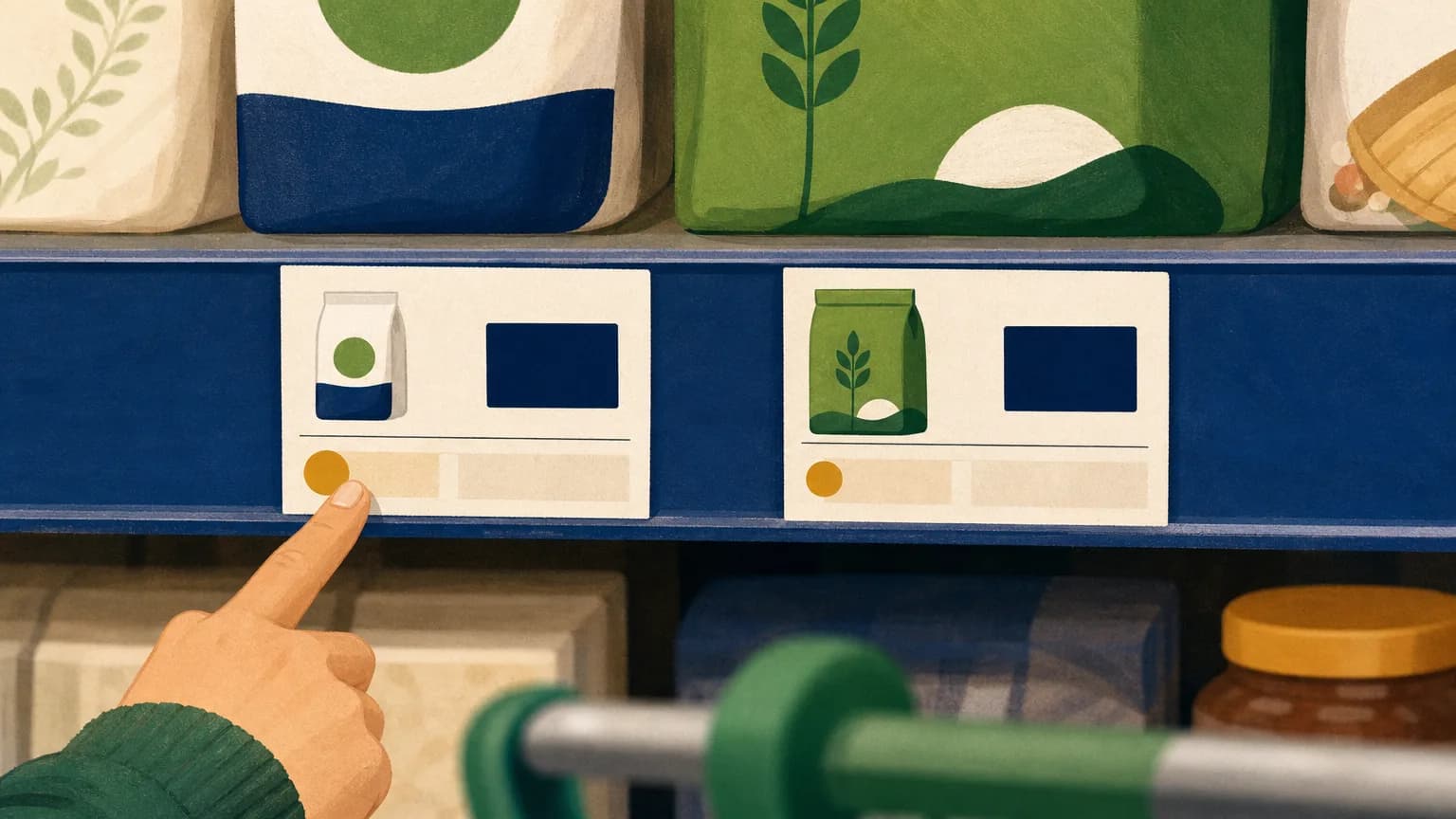
There is no single cheapest supermarket in the UK for everything you buy, so the cheapest weekly shop is the one you price line by line rather than shop by shop. Do that once with the 20 or so items you actually buy every week, using the unit price on the shelf edge, and you will not need to keep re-checking.
That is the whole job. Everything below is how to do it quickly, and how to avoid the traps that make a "cheap" shop cost more.
Why one shop is never cheapest for everything
Supermarkets do not price as a block. They price categories, and they take turns being cheapest on nappies, chicken thighs, coffee or washing powder.
That is why national league tables only get you so far. A basket of 100 items tells you about the average shopper, not about your household with a lactose-free child and a dog.
Even the regulator ran into this. When the Competition and Markets Authority (the government body that polices competition and consumer law) studied supermarket loyalty pricing, it excluded Aldi and Lidl from its comparative analysis because neither sold online at the time nor stocked enough branded products for a like-for-like comparison.
So the practical answer is your own list, priced where you can actually get to.
Unit pricing: the small print that does the work
The unit price is the small figure on the shelf label showing price per kilogram, per litre, per 100g or per item. It is the only number that lets you compare a 500g bag with a 1.2kg bag, or a branded jar with an own-brand tub.
In Great Britain this is a legal requirement under the Price Marking Order 2004, and Department for Business and Trade guidance says the selling price and unit price must be unambiguous, clearly legible and close to the product or its online description. Northern Ireland has its own Price Marking Order (Northern Ireland) 2004, which the Competition and Markets Authority describes as essentially replicating the Great Britain rules.
Two things worth knowing:
- Small shops are exempt. The Competition and Markets Authority's May 2024 review of price marking notes that shops with a relevant floor or display area under 280 square metres do not have to show unit prices. That is why the corner shop often shows no price per kilogram.
- The rules are tightening. Under the Price Marking (Amendment) Order 2024 on legislation.gov.uk, from 6 April 2026 unit prices must be shown in consistent metric units, and selling and unit prices must be displayed for promotions, multi-buys and loyalty discounts. A lot of commentary still carries an older date of October 2025; the in-force date is now April 2026.
Until then, the loyalty-price shelf label is the one where the unit price is most often missing or hard to compare. Do that sum in your head, or on your phone.
How to do a supermarket price comparison in ten minutes
- Write down the 15 to 25 things you buy nearly every week.
- For each one, note the unit price, not the pack price.
- Do it in two shops you can reach without a special trip.
- Circle the five biggest gaps. Those five are your whole saving.
- Ignore the rest. Chasing 4p on tinned tomatoes is not worth an evening.
Own brand versus branded: where the drop actually shows
Most supermarkets run three rough tiers: a value line, a standard own brand and a premium own brand. Swapping branded for standard own brand is usually the single biggest cut available on a weekly shop.
There is no regulator finding on where quality falls off, so treat this as shopper experience rather than fact. In practice, households tend to report the smallest difference on staples that are basically one ingredient — flour, sugar, rice, frozen peas, tinned pulses, bleach, kitchen roll — and the biggest difference on things where meat, fruit or fat content does the work, such as sausages, ready meals, jam and biscuits.
If you want a hard check rather than a hunch, read the label. GOV.UK's food labelling guidance covers compositional standards, and ingredients are listed in descending order by weight, so a value sausage with a lower meat percentage will show it.
Buy one tier down on a few items, not everything at once. If two swaps get rejected at the table, you have lost very little.
Loyalty pricing: what the regulator found and what to watch
In November 2024 the Competition and Markets Authority published its findings on supermarket loyalty pricing. It concluded that loyalty prices offered genuine savings against the equivalent non-member price, and found little evidence that non-member prices were being inflated during promotions.
That matters, because its own survey found 55% of shoppers believed non-member prices were pushed up during offers.
But the regulator's caveat is the bit to hold on to: a loyalty price can still be beaten elsewhere at any given time. A yellow loyalty label means cheaper than the same shop's normal price. It does not mean cheapest anywhere.
The Competition and Markets Authority also said supermarkets should do more so that shoppers without smartphones, and older shoppers, can join and use these schemes. If that is you, ask at the customer service desk for a physical card.
Check the shelf price against your receipt
The same regulator inspected stores and found at least one price error in just over half of those it visited, and in 88% of errors at variety stores the customer paid more than the price on display. It saw a 250g jar of Marmite labelled £2.85 scan at £4.19.
Citizens Advice explains your position clearly. If a shelf price is a genuine mistake, you do not have the right to buy at the lower price, though you can ask. But if you have already paid more than the advertised price, you can return the item in its original condition and they must refund you.
The Citizens Advice consumer helpline is 0808 223 1133; in Northern Ireland, contact Consumerline instead.

Markdowns only save money if they get eaten or frozen in portions you will cook.
Splitting your shop without spending more on fuel
Splitting the shop only works if the second stop is on a route you already drive — the school run, the way home from work, next to the pharmacy.
Use a rough cost per mile so you can see when the trip eats the saving. HMRC's approved mileage rate for cars is 45p a mile for the first 10,000 miles, and that covers running costs as well as fuel. On that basis a five-mile round trip is about £2.25 before you have bought anything.
So the rule of thumb is simple: a dedicated extra journey needs to save you a fiver to be worth it. A stop you were making anyway needs to save you nothing at all.
Reduced sections, freezing and waste: the real saving
The biggest saving in most kitchens is not the shop you choose. It is the food you throw away.
Reduced items only save money if they get eaten or frozen. The Food Standards Agency's advice is that you can freeze food right up to and including the use-by date, and that the safest way to defrost is in the fridge, then use it within 24 hours. Once cooked, food can be frozen again.
A few habits that work:
- Learn your shop's markdown time and go once a week, not every day.
- Freeze in portion sizes you will actually cook.
- Treat "best before" as quality and "use by" as safety. Only the use-by date is about whether food is safe.
- Label bags with what and when, or you will find a mystery brick in March.
If money has run out before the shop, that is not a budgeting failure. Our food bank finder shows what is near you and how referrals work.
Questions people ask
Which is the cheapest supermarket in the UK right now?
No shop is cheapest across the board, and rankings shift week to week as promotions change. Pricing your own regular list in two nearby shops will beat any national table for your household.
Is the unit price always shown?
Not always. Shops under 280 square metres of relevant floor area are exempt under the price marking rules, and loyalty and multi-buy labels are currently the weakest area — though from 6 April 2026 the amended Price Marking Order requires prices to be shown for promotions and loyalty discounts too.
Are loyalty prices a con?
The Competition and Markets Authority found they were genuine savings against the non-member price, and little sign of inflated non-member pricing. It also warned that a loyalty price can still be beaten elsewhere, so it is not proof of the cheapest deal.
Can I insist on the shelf price if the till charges more?
Citizens Advice says you cannot insist on a mispriced shelf price, but you can ask, and many staff will honour it. If you have already paid over the advertised price, you can return the item and get a refund.
Does online shopping work out cheaper?
It removes impulse buys and shows unit prices in one place, which helps. Weigh that against delivery charges and substitutions, which can quietly undo the saving.
What to do next
Price your own regular list once, rather than trying to pick one cheapest supermarket. Put your items into your shopping list, priced at each discounter and you will see the gaps in minutes.
- Compare everyday staples on Shop smarter
- Find markdowns near you with the yellow-sticker radar
- See what shoppers locally are actually paying on the local food price index
- If the second shop means a detour, check pump prices first on cheapest fuel near you
And if the weekly shop is being squeezed by debt, speak to StepChange, National Debtline or Citizens Advice. Their advice is free and independent, and LiveCheaper is not a financial adviser.
Where this comes from
- Price Marking Order 2004: government guidance (Department for Business and Trade, 22 September 2025)
- The Price Marking (Amendment) Order 2024 (SI 2024/1055)
- CMA review of price marking in the groceries sector (8 May 2024)
- CMA: Loyalty pricing in the groceries sector — findings (27 November 2024)
- Citizens Advice: If something is advertised at the wrong price
- CMA: Unit pricing in the groceries sector
- Food Standards Agency: Chilling, freezing and defrosting food safely
- GOV.UK: Food labelling — giving food information to consumers
Would this answer somebody else’s question too?